 |
| THREE THINGS YOU NEED TO SEPERATE NITROGEN FROM AIR |
|
 First : BF Technology First : BF Technology
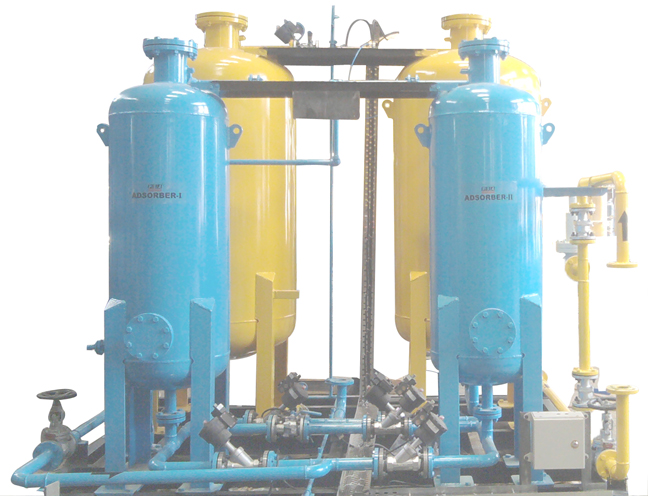
The idea of separating nitrogen from air by an adsorptive process was equally off-beat as it was fascinating. But in the early 70's Bergbau-Forschung managed just that. Since then we licence the BF- Process to separate nitrogen from air worldwide. This process is based on the Molecular Sieve Effect Facilitated by special custom-made activated carbon.The principle of the process is surpris- ingly simple and very effective. Two adsorbers, used alternately, are filled with the Carbonaceous Molecular Sieve or CMS. To begin with, one of the two adsorbers is filled with air under pressure.Then, the Molecular Sieve adsorbs mainly oxygen, and a nitrogen rich gas leaves the adsorber.
Simple pressure reduction regenerates the first adsorber. In the meantime the second adsorber starts the production cycle. Cycle times of as short as 1-2 minutes for adsorption and desorption ensure a constant nitrogen supply. |
|
Second : The Carbonaceous Moleculer Sieve
Our subsidiary, Carbo-Tech, has pioneered the scale-up of the production of narrow pored Carbonaceous Molecular Sieves to an industrial level.In one multi-step process an ultra-fine, pore structure is formed in the molecula sieve pellets. This structure facilitates easy separation of different sized oxygen and nitrogen molecules. CMS is the crucial element of any PSA Plant utilizing the BF-Process. We know the raw material right down to the finest pore-sub-bituminous coal. The resulting characteristics of CMS are unique. It is highly resilient towards long term pressure swing usage. Moreover, the excellent auto-regenerative characteristic of the sieve leads to many years of high quality nitrogen production.
Hence, one CMS charge lasts as long as the PSA-Plant. This makes it a safe long term investment. |
|
| |
Third : The Plant
Those that choose a pressure swing adsorption plant utilizing our process have good reasons. Our business partners value synergistic effects between the process, CMS, and the plant. This results in advantages rarely combined in one process. Here are some examples to prove this in terms of progress and economics. |
The first example concerns the particularly long plant life, the second the fully automated operation of the plant. In fact, after the first day there are no personnel costs since the plant runs fully automated and trouble-free. The low energy costs are doubly advantageous as they result in lower over-heads and a cleaner environment. Nitrogen is all around us, and it is surprisingly easily separated, given three things - our process, the CMS, and the plant. Facts and figures prove our performance - more than 5000 plants are in operation worldwide utilizing the BF-Process and the trend is rising. |
|
| In addition to nitrogen, hydrogen can also be separated from process and coking gas; methane from landfill and pit gas; and helium from natural gas. In these cases it is also true that the "simpler" the principle, the more broadly based is its success. |
| |
|
|



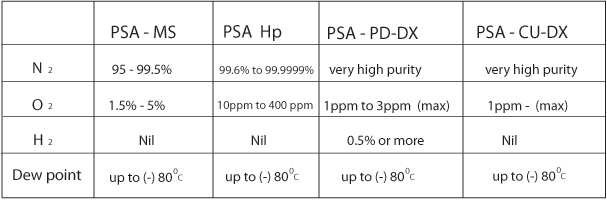
 For bright annealing, hardening, tempering and other heat treatment applicaton in metallurgical industries.